
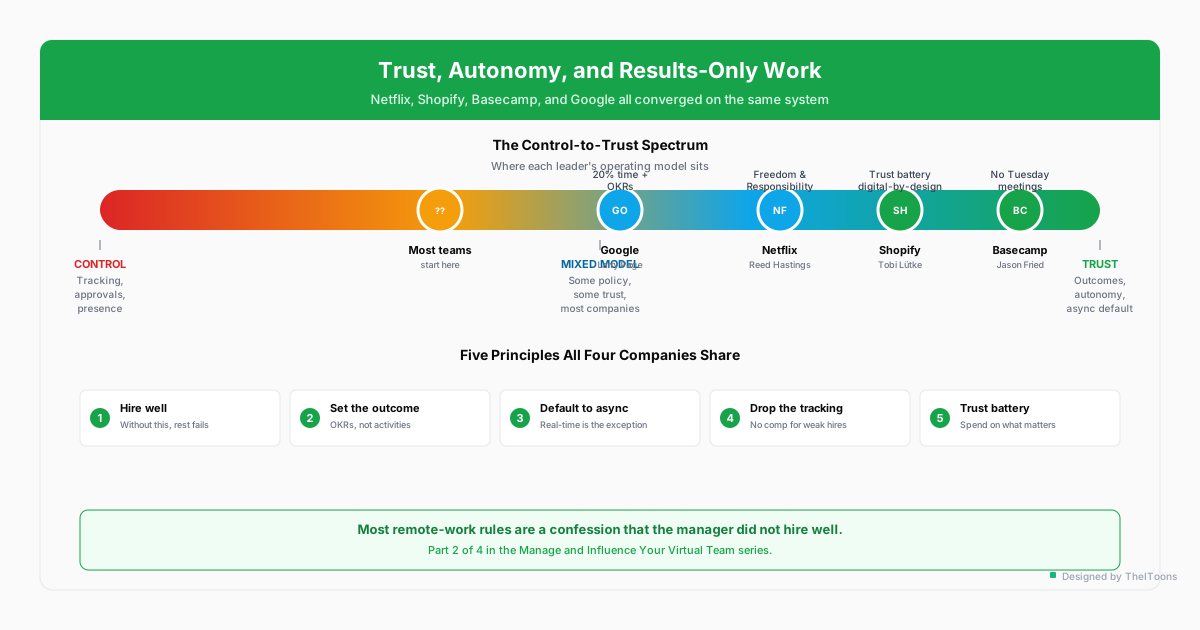
Most remote-work rules are a confession that the manager did not hire well.
This is the uncomfortable premise underneath the four playbooks in this article. Reed Hastings at Netflix, Tobi Lütke at Shopify, Jason Fried at Basecamp, and the early Google team all arrived at the same system from different directions: strip the rules, expand the autonomy, and treat the employee as a fully-formed adult. The differences are in execution, not principle.
This is Part 2 of a four-part series on managing and influencing virtual teams.
- Part 1: Communication playbooks from the C-suite
- Part 2: Trust, autonomy, and results-only work (you are here)
- Part 3: Culture and belonging at a distance
- Part 4: Hiring, onboarding, and performance management
Reed Hastings: freedom is the strategy
Netflix under Reed Hastings is the most-cited case study in modern remote-and-flexible work. The reason is simple: Netflix has been running a results-only work environment since the late 2000s, well before the pandemic made the phrase common.
The principle, as documented in Hastings's 2009 internal slide deck (the "Netflix Culture Deck") and his 2020 book No Rules Rules, is "freedom and responsibility." The deck has been viewed more than 30 million times. It is the most-read internal corporate document of the last twenty years.
Two specific policies are the ones that made the system concrete. Both are sourced directly from primary reporting and Hastings's own writing.
First, vacation policy. Netflix eliminated sick days and vacation days. Employees manage their own time off. The premise is that adults know when they need a break and do not need a form to take one. The reporting from Netflix's HR team (including former Chief Talent Officer Patty McCord) is that the policy has not produced an absenteeism problem. It has produced a higher-trust culture.
Second, the severance package for mediocrity. Netflix pays out generous severance to employees whose performance is "adequate" but not "great." The mechanism is described in Hastings's own writing and is the most controversial part of the system. The logic, stripped to the bones, is that adequate performers slow the team down, and a clean severance is cheaper than the drag. Hastings frames it bluntly: a great workplace is not a workplace where everyone stays forever. It is a workplace where everyone is doing the best work of their career.
The system at Netflix, distilled:
- Hire well. This is the prerequisite. Without it, the rest of the system collapses.
- Eliminate process that exists to compensate for weak performers.
- Pay top of market. Hastings has said repeatedly that the goal is to be in the top 1% of compensation for every role.
- Be honest about performance. Mediocrity is a problem to solve, not a person to retain.
The relevance to virtual teams is direct. Most remote-work policies (time-tracking, mandatory camera-on, daily standups, approval gates) exist because the manager is not confident that the work is getting done. If you have hired well and set clear outcomes, those policies disappear.
Tobi Lütke: office centricity is over
Shopify's CEO Tobi Lütke made the most aggressive distributed-work bet of any major tech CEO in 2020. In a public statement that May, he announced that Shopify would be "digital by design" permanently. The company's offices would be retained for in-person collaboration, but the default mode of work would be remote.
The full text of the statement is on Shopify's blog and was widely covered at the time. The relevant passage:
As of today, Shopify is a digital-by-design company... We will keep our offices open for those who want to use them, but the future of work is not where you go, it's what you do. Tobi Lütke, Shopify blog, May 2020
The policy was not a pandemic accommodation. Lütke framed it as a permanent shift in the company's operating model. Two years later, in 2022, he followed it up with a memo titled "Reflections on Digital by Design" that walked through what worked and what broke. The principle was the same: the office is a tool, not a default.
The mechanism Shopify uses is what Lütke calls the "trust battery." Every interaction either charges it or drains it. A manager who checks in on an employee daily drains the battery. An employee who ships work on time and communicates clearly charges it. The goal is to keep the battery charged so that the manager does not need to track.
The system at Shopify, distilled:
- Default to async, escalate to sync.
- Replace physical presence with documented outcomes.
- Measure trust as a balance. Spend it on the things that matter; do not drain it on surveillance.
- Treat the office as a collaboration tool, not a control mechanism.
The relevance to virtual teams is similar to Netflix's. The first reaction to distributed work is to add tracking. The Lütke insight is to subtract tracking. The work itself is the signal.
Jason Fried and Basecamp: the calm company
Jason Fried co-founded Basecamp (originally 37signals) in 1999. The company has been remote or remote-friendly for most of its history. Fried's 2013 book Remote: Office Not Required is the most-cited book-length argument for distributed work in the management canon. His 2019 follow-up with David Heinemeier Hansson, It Doesn't Have to Be Crazy at Work, extends the argument.
Fried's core claim is that the office is not where work happens. The office is where interruption happens. The work happens when the team is heads-down, in long uninterrupted blocks, in whatever environment produces the best output.
Two specific Basecamp policies carry the principle:
First, the "no Tuesday meetings" rule. Basecamp bans meetings on Tuesdays. The day is reserved for focused work. Meetings on other days are limited and have to be justified. The mechanism is described in Fried's writing and on Basecamp's blog.
Second, the four-day summer schedule. Basecamp runs a four-day work week during the summer. The experiment has been repeated several times. The output, by every measure the company tracks, has held steady or improved. The implication is that the eight-hour day is a relic of factory work.
The Basecamp system, distilled:
- Default to writing. Use real-time meetings only for decisions that need them.
- Protect the focused block. Tuesdays, mornings, or whatever the team's choice. Do not interrupt it.
- Reduce the calendar. A packed calendar is not a sign of productivity. It is a sign of reactivity.
- Trust the work. Output is what matters. Where and when it happens is the team's call.
Fried's contribution to the virtual-team playbook is the cultural permission slip. The other three leaders in this article wrote policies. Fried wrote the argument that the policies were unnecessary if the underlying culture is right.
The early Google: 20% time and the talent flywheel
Google's early culture is harder to source than Netflix or Shopify because much of it has been written by former employees rather than by the company. But three documented principles shaped the system that powered Google's distributed growth through the 2000s.
First, the 20% rule. Engineers were expected to spend 20% of their time on projects of their own choosing. The list of products that came out of 20% time includes Gmail, AdSense, and News. The policy is widely cited in coverage of Google's early culture.
Second, OKRs. Andy Grove introduced Objectives and Key Results at Intel in the 1970s and wrote about them in High Output Management in 1983. John Doerr brought the framework to Google in 1999. The framework spread from there to most of Silicon Valley. OKRs are an autonomy-and-accountability tool: the employee sets the objective, the manager agrees on the key results, and the rest of the process is owned by the employee.
Third, the talent flywheel. Eric Schmidt, Google's CEO from 2001 to 2011, articulated the principle in his 2014 book How Google Works and in a 2010 Wall Street Journal interview:
I actually think most people don't want Google to answer their questions. They want Google to tell them what they should be doing next. Eric Schmidt, Wall Street Journal interview, August 2010
The implication for management is that the manager's job is not to direct. It is to suggest. The manager provides the data, the team makes the call. Schmidt's quote captures the philosophy: the manager is a recommendation engine, not a control system.
The Google system, distilled:
- Set the outcome, not the activity. OKRs define what success looks like. The path is the team's call.
- Allow pursuit. 20% time is not the literal number. The principle is that some fraction of time belongs to the employee, not the manager.
- Be a recommendation engine. Tell people what they should be doing next, not what to do.
- Hire people who do not need supervision. The Google interview loop is famous because it screens for exactly this.
The relevance to virtual teams is that the system is built for distributed work even when no one at Google was calling it that. OKRs are async. 20% time requires trust. The talent flywheel requires that you have already hired well.
What all four playbooks have in common
Four leaders, four companies, one principle: the system that works for distributed work is the system that works for any high-trust organization. The remote piece is incidental. The hard part is the trust piece.
The five moves that show up in every playbook:
- Hire well. Without this, the rest is theater.
- Set the outcome. Use OKRs, KPIs, or whatever fits. The output is the contract.
- Default to async. Real-time meetings are expensive. Use them only when needed.
- Eliminate process that exists to compensate for weak performers. If you have to track the work, you have the wrong people.
- Pay attention to the trust battery. Every interaction is either a charge or a drain.
If you are running a virtual team and you are adding more process, the answer is almost never "more process." The answer is almost always "better hires and clearer outcomes."
What it looks like in practice
A trust-based distributed team looks like this from the inside.
The team's calendar is mostly empty. There is a weekly 30-minute decision block. There is a monthly retrospective. There is a quarterly planning session. There are one-on-ones, but they are short and infrequent. The rest of the time, the team is heads-down.
The team's primary communication is writing. Slack is for questions, not for status updates. The status updates are in the project doc. The decisions are in the meeting notes. The asynchronous loop is the default.
The manager's job is to set the context, approve the trade-offs, and remove blockers. The manager does not review every commit, attend every meeting, or approve every expense. The manager trusts the team to do the work.
The output is what matters. The team ships on time, the quality is consistent, and the team has the energy to keep shipping. The team is also stable: turnover is low, engagement is high, and the people who do leave are leaving for clear reasons (career change, life event) rather than frustration with the system.
This is not the system most companies run. Most companies run the opposite: packed calendars, constant check-ins, approval gates on small decisions, and a culture where the manager is the bottleneck. The shift from one to the other is not complicated. It is just uncomfortable, because it requires the manager to give up control.
The uncomfortable part
If you are a manager reading this and feeling defensive, the right question to ask is: which of my policies exist because the work requires them, and which exist because I am not confident the work is getting done?
Most managers will find that the majority of their policies are in the second category. The first category is usually much smaller than they think.
The reason is that hiring is hard. Most managers have not been trained to hire well. Most companies do not have a rigorous interview loop. Most teams have one or two people who are not pulling their weight, and the manager's response is to add process that slows everyone down.
The trust-based system does not work if you have not solved the hiring problem. If you have a weak performer on the team, the system will break. If you have hired well, the system will run itself.
This is why the hiring and performance piece is Part 4 of this series. Trust without hiring is theater. Hiring without trust is surveillance. The two together are the operating system of every distributed team that has actually shipped at scale.
Next in the series
Part 3 covers culture and belonging. Most distributed teams fail not at communication or trust but at the harder question: how do you make people feel like they belong when they have never met in person? That piece covers GitLab's all-remote handbook, Mary Barra at GM, and Sheryl Sandberg's argument that inclusion is a strategic asset.
Read Part 3: Culture and Belonging at a Distance →
Sources
- Hastings, R., & Meyer, E. (2020). No Rules Rules: Netflix and the Culture of Reinvention. Penguin Press.
- McCord, P. (2017). Powerful: Building a Culture of Freedom and Responsibility. Harper Business.
- Lütke, T. (May 2020). The Future of Shopify is Digital by Design. Shopify Blog.
- Lütke, T. (2022). Reflections on Digital by Design. Shopify Blog.
- Fried, J. (2013). Remote: Office Not Required. Crown Business.
- Fried, J., & Hansson, D. H. (2019). It Doesn't Have to Be Crazy at Work. Harper Business.
- Schmidt, E., & Rosenberg, J. (2014). How Google Works. Grand Central Publishing.
- Doerr, J. (2018). Measure What Matters. Portfolio.
- Grove, A. S. (1983). High Output Management. Andrew S. Grove.
- Wikipedia: Reed Hastings, Tobi Lütke, Jason Fried, Eric Schmidt (accessed June 2026).
Ready to Build a Distributed Brand That Scales?
If you're scaling a remote or distributed team and you need to translate the operating system into a brand and product that ships at scale, we'd like to be part of the conversation.
If you're not ready to talk yet, subscribe below. We send one email a week with practical takes on distributed leadership, branding, and what actually works for growth-stage companies. No fluff, no sales sequence.