
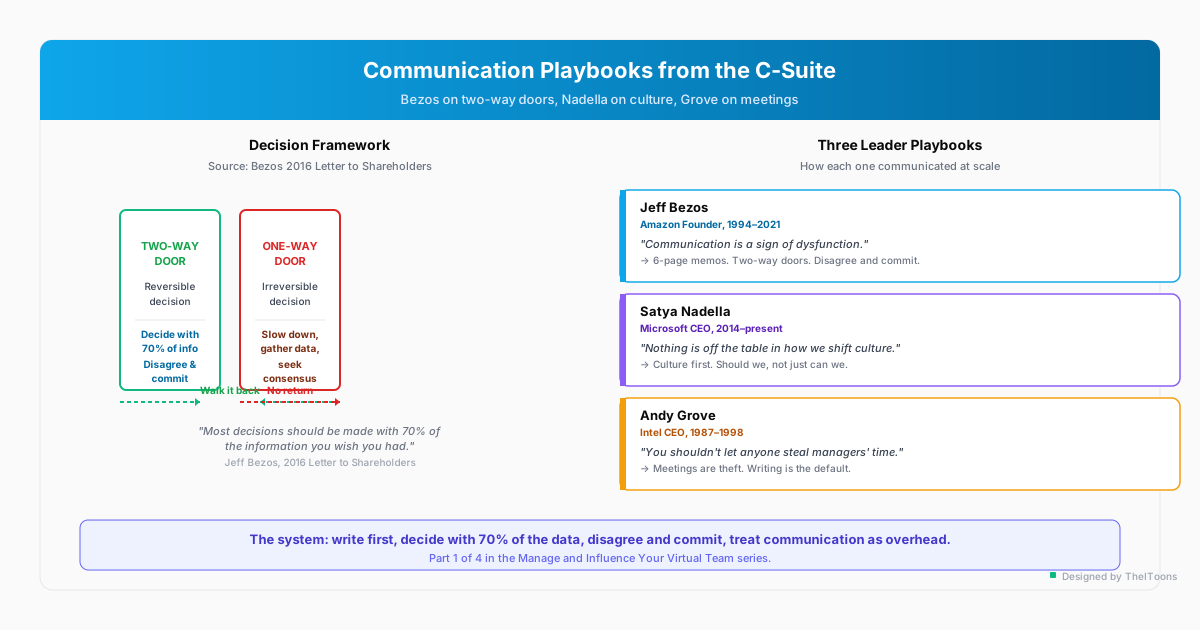
Most managers treat communication as a tool. The C-suite leaders who scaled remote work treat it as a system. Three of them in particular have published, on the record, exactly how they think about it.
This is the first article in a four-part series on managing and influencing virtual teams. The other three cover trust and autonomy, culture and belonging, and hiring and performance. If you want to read them as a set, here is the series index.
- Part 1: Communication playbooks from the C-suite (you are here)
- Part 2: Trust, autonomy, and results-only work
- Part 3: Culture and belonging at a distance
- Part 4: Hiring, onboarding, and performance management
Each piece pulls from primary sources: shareholder letters, internal emails, books, and on-the-record interviews. The quotes are real, the dates are real, and the attributions link back to where each leader said what they said.
Jeff Bezos: written-first, narrative over slides, and the two-way door
Bezos's communication philosophy is the most explicit of any modern CEO. He has published two shareholder letters that lay out the system in full: the 1997 letter that introduced it, and the 2016 letter that refined it for a global, distributed Amazon.
The 1997 letter, written when Amazon was a small online bookstore, listed the company's "three big ideas." Communication was not one of them, but the way the company ran them set the pattern:
We've had three big ideas at Amazon that we've stuck with for 18 years, and they're the reason we're successful: Put the customer first. Invent. And be patient. Jeffrey Bezos, 1997 letter to shareholders
The patience part is what people miss. Customer-first thinking forces you to write things down, because the customer is not in the room. Inventing at Amazon's scale forces you to ship memos instead of slides, because the people making the decision are not in the room either.
The 2016 letter, written when Amazon had hundreds of thousands of employees across dozens of time zones, made the system explicit. Three passages matter most for virtual teams.
First, the two-way door.
Many decisions are reversible, two-way doors. Those decisions can use a light-weight process... Most decisions should probably be made with somewhere around 70% of the information you wish you had. If you wait for 90%, in most cases, you're probably being slow. Jeffrey Bezos, 2016 letter to shareholders
The point of the two-way door is that it removes the cost of being wrong. Most decisions in a remote team are reversible: the design choice you can rework, the copy you can rewrite, the architecture you can refactor. Treat them as reversible and you can move at the speed of writing rather than the speed of meetings.
Second, disagree and commit.
Use the phrase "disagree and commit." This phrase will save a lot of time. If you have conviction on a particular direction even though there's no consensus, it's helpful to say, "Look, I know we disagree on this but will you gamble with me on it? Disagree and commit?" By the time you're at this point, no one can know the answer for sure, and you'll probably get a quick yes. Jeffrey Bezos, 2016 letter to shareholders
This is the line that lets distributed teams move fast. You do not need full alignment to ship. You need a decision, a clear owner, and a team that has registered its objections once. After that, everyone runs.
Third, communication as a signal of dysfunction. This one is from a different primary source, Brad Stone's 2013 book The Everything Store:
Communication is a sign of dysfunction. It means people aren't working together in a close, organic way. We should be trying to figure out ways for teams to communicate less with each other, not more. Jeff Bezos, as reported in The Everything Store by Brad Stone
Read this carefully. Bezos is not arguing for silence. He is arguing that the need to communicate is a tax you pay when teams are not aligned. If your distributed team is in Slack all day, the system is broken. If they are heads-down and reach for Slack only when they need to, the system is working.
The Amazon communication playbook, distilled:
- Write the six-pager instead of the slide deck. Reading is faster than listening, and a written memo is asynchronous by default.
- Decide with 70% of the information. The cost of slow is higher than the cost of wrong.
- Disagree and commit. The decision belongs to the owner, and the team moves.
- Treat communication as overhead, not value-add. The goal is to need less of it, not more.
Satya Nadella: culture is the operating system
Nadella took over Microsoft in February 2014. Three months later he sent an internal email to all employees that became the foundation of everything the company did for the next decade. The relevant excerpt:
Nothing is off the table in how we think about shifting our culture to deliver on this core strategy. Organizations will change. Mergers and acquisitions will occur. Job responsibilities will evolve. New partnerships will be formed. Tired traditions will be questioned. Our priorities will be adjusted. New skills will be built. New ideas will be heard. New hires will be made. Processes will be simplified. And if you want to thrive at Microsoft and make a world impact, you and your team must add numerous more changes to this list that you will be enthusiastic about driving. Satya Nadella, internal email to Microsoft employees, February 2014
The quote is striking for what is missing: nothing about products, markets, or competitive threats. The whole email is about how the company communicates and decides. Nadella understood that in a company that size, especially one pivoting from Windows licensing to cloud, the only thing faster than the technology shift was the cultural shift.
Two more Nadella quotes carry the same logic.
On failure as a precondition for learning, from a December 2015 interview with Boy Genius Report:
When I think about my career, my successes are built on learning from failures. Satya Nadella, BGR interview, December 2015
On the limits of what technology should do, from his 2018 Microsoft Build keynote:
We need to ask ourselves not only what computers can do, but what computers should do. Satya Nadella, Microsoft Build keynote, May 2018
The second quote is the one that translates best to remote leadership. Distributed teams make a thousand small decisions a day about what to automate, what to monitor, what to report on. The framework "should we" is more useful than "can we."
The Nadella communication playbook, distilled:
- Lead with culture change, not product change. The faster the company moves, the more important the underlying agreement.
- Build psychological safety into the failure vocabulary. People report bad news early when they expect to learn from it.
- Frame decisions around ethics, not just capability. "Should we" is a higher bar than "can we."
- Make the operating system explicit. Microsoft under Nadella published its culture memo publicly. Your team needs the same written record.
Andy Grove: meetings are theft, chaos is the default
Andy Grove ran Intel from the late 1960s through the 1980s. He wrote High Output Management in 1983. The book is a cult classic in Silicon Valley: Mark Zuckerberg, Evan Williams, Brian Chesky, and Ben Horowitz have all publicly cited it as foundational. It is also the most operational management text ever written by a CEO.
The principle that matters most for distributed teams is Grove's view of meetings.
Just as you would not permit a fellow employee to steal a piece of office equipment worth $2,000, you shouldn't let anyone walk away with the time of his fellow managers. Andrew S. Grove, Computer Decisions, 1984
Grove's point is not that meetings are bad. It is that they are a transfer of time from the people in them to the person who called them. A meeting that runs long with no agenda is, in his framing, a $2,000 theft from every manager in the room.
For remote teams, this maps to the standing meeting problem. A weekly hour-long all-hands is a 2% tax on every employee's week. Four of them is 8%. Most of that time is recoverable if you replace it with a written update and a 15-minute decision block.
The other Grove principle that maps cleanly to distributed work is his chaos-management framework, from his 1995 book Swimming Across:
Let chaos reign, then rein in chaos. Andrew S. Grove, Swimming Across, 1995
Distributed work is inherently more chaotic. The signal is weaker. The feedback loops are slower. The temptation is to over-control through process, more meetings, more approval gates. Grove argues the opposite. Let the system be chaotic. Then intervene only at the leverage points.
Grove's communication playbook, distilled:
- Treat meetings as a budget, not a default. Every meeting has a cost; spend the budget on the ones that change decisions.
- Default to writing, escalate to synchronous only when needed.
- Let chaos run. Intervene at leverage points, not everywhere.
- Measure the manager's output, not their busyness. Grove's central contribution was the idea that a manager's output equals the output of their organization. A busy manager with no shipped work is a failed manager.
What this means for a virtual team
If you take these three playbooks seriously, the system you are building looks like this.
Most decisions are made in writing, on a shared doc, with the owner named at the top. A comment thread is the meeting. A pull request is the decision.
Synchronous time is reserved for the small number of decisions that need a real-time back-and-forth: launches, escalations, one-on-ones, and the disagreement that "disagree and commit" could not resolve on paper.
The communication load is measured. If the team is in Slack all day, the doc is wrong. If the team is heads-down for most of the week and surfaces only for the weekly decision block, the system is working.
The culture is explicit. The new hire reads the memo on day one. The senior leader reads it on day 365. Both get the same answer to the question "how do we work here."
None of this is original to these three leaders. Most of it is in High Output Management, which Bezos almost certainly read. The point is not that Bezos, Nadella, and Grove invented distributed work. The point is that they are the ones who wrote down the playbook when the rest of the world was still figuring it out.
If you are running a virtual team today, you do not need to invent the system. You need to apply it.
Next in the series
Part 2 covers trust and autonomy: Reed Hastings at Netflix, Tobi Lütke at Shopify, Jason Fried at Basecamp, and the idea that most rules exist because someone failed to hire well. That piece publishes next week.
Read Part 2: Trust, Autonomy, and Results-Only Work →
Sources
Each quote links to a primary source where available:
- Bezos, J. (1997). 1997 Letter to Shareholders. [Amazon Investor Relations archive]
- Bezos, J. (2016). 2016 Letter to Shareholders. [Amazon Investor Relations archive]
- Bezos, J., quoted in Stone, B. (2013). The Everything Store: Jeff Bezos and the Age of Amazon. Little, Brown and Company.
- Nadella, S. (February 4, 2014). Internal email to Microsoft employees, "Meet the new CEO." Microsoft.
- Nadella, S. (December 2015). Interview, Boy Genius Report.
- Nadella, S. (May 7, 2018). Microsoft Build keynote, Seattle.
- Grove, A. S. (1984). Interview, Computer Decisions, Vol. 16.
- Grove, A. S. (1995). Swimming Across: A Memoir. Warner Books.
- Grove, A. S. (2000). What I've Learned. Esquire, May 1, 2000.
Ready to Build a Brand That Ships?
If you're running a remote or distributed team and need to communicate it well, through your brand, your site, or your product, we'd like to be part of the conversation.
If you're not ready to talk yet, subscribe below. We send one email a week with practical takes on remote leadership, branding, and what actually works for growth-stage companies. No fluff, no sales sequence.