
Most articles about startup branding budgets lie. They promise a "full brand identity" for $500. They list five logo sites and call it a brand strategy. They tell you to use a Fiverr designer and ship the same week. None of that is real.
Here is what is real. Each tier of brand budget buys a different thing, not a smaller version of the same thing. A $500 logo is not a $50,000 brand on a discount. It is a different product with a different lifespan. The job is to match the spend to the decision you are actually trying to make.
This is the framework we walk through with founders before they spend anything on branding at TheIToons. It comes from 40+ engagements where we have seen the cheap end, the expensive end, and the messy middle where most startups end up.
The three tiers, with what each one buys
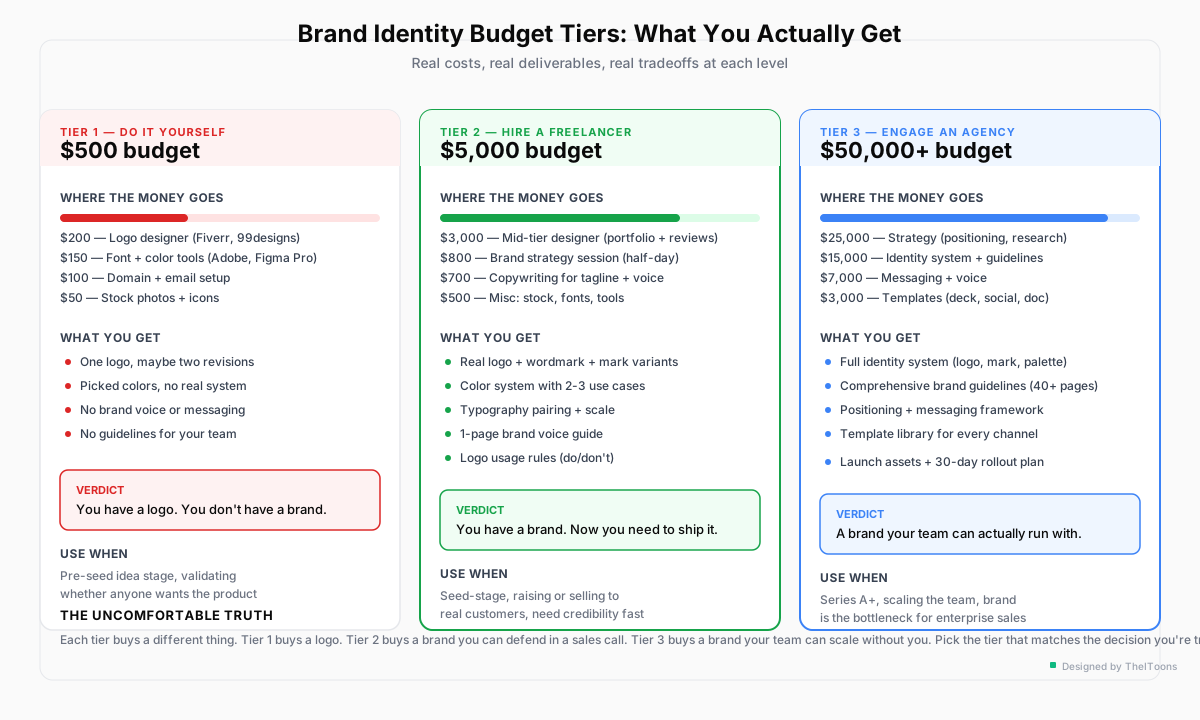
Tier 1: $500 - the logo tier
This is the budget most pre-seed founders have. Spend it on a logo. That is all you are buying.
Where the money goes at $500:
- $200 on a Fiverr or 99designs logo designer
- $150 on a font subscription and Figma Pro
- $100 on domain registration and email setup
- $50 on stock photos and a small icon set
What you get: one logo file, maybe two rounds of revisions, a color palette you picked yourself from a Pinterest board, and the feeling that you have done the brand thing.
What you do not get: a brand voice. A messaging hierarchy. Guidelines your co-founder or first hire can follow. A logo that survives being placed on a dark background, resized for a business card, or stretched across a conference booth. Most $500 logos are vector files with no usage rules, so they break the moment your designer leaves the relationship.
The honest use case for this tier: you are at the idea stage, you have not yet sold anything, and you are testing whether anyone wants the product. Brand is not the bottleneck yet. Speed is. Ship the logo, get a landing page up, start conversations. You can rebuild later when the product is real.
Tier 2: $5,000 - the freelancer tier
This is where most seed-stage companies should land. The jump from $500 to $5K buys you a brand that survives contact with real customers.
Where the money goes at $5,000:
- $3,000 on a mid-tier freelance designer (look for a portfolio with 3-5 B2B SaaS clients, not $200 logo mills)
- $800 on a half-day brand strategy session (yours or a consultant, not the designer)
- $700 on copywriting for a tagline, voice guide, and key product descriptions
- $500 on fonts, stock imagery, and tool subscriptions
What you get: a real logo system with a primary mark, secondary mark, and a wordmark that work together. A color system with two or three defined use cases (light mode, dark mode, accent on a CTA). Typography pairing and a scale. A one-page brand voice guide. Logo usage rules so your team knows what not to do.
What you do not get: a 40-page brand book. A positioning framework backed by customer research. Templates for every channel. A launch plan.
The honest use case for this tier: you are raising a seed round, you are about to start outbound sales, or you have paying customers and you need to look like the company you are becoming. Brand credibility is now the bottleneck. Tier 1 will hurt you in a sales call. Tier 2 will not.
Tier 3: $50,000+ - the agency tier
This is the budget for Series A companies where brand has become a sales bottleneck or where you are scaling the team and need a system that does not require the founder to personally enforce it.
Where the money goes at $50,000:
- $25,000 on strategy: positioning work, customer research, competitive analysis, messaging framework
- $15,000 on the identity system: logo, visual language, color, typography, motion principles
- $7,000 on messaging and voice: tagline, value props, copy direction
- $3,000 on launch templates: pitch deck, social templates, document templates, sales one-pager
What you get: a brand your team can run with. A positioning document that explains why you exist in a way a new VP of Sales can read once and use. A 40+ page brand guideline that survives the founding designer leaving. A template library for every channel you ship on. A 30-day rollout plan that walks the team through the launch.
What you do not get: a guarantee of results. A brand is positioning plus identity plus execution. The agency can hand you the system. Your team still has to use it.
The honest use case for this tier: you have raised Series A or B, you are scaling sales, and the brand is now a real or perceived barrier to enterprise deals. Or you are about to launch a new product line and need a brand that holds up across multiple surfaces. The $50K is for the system, not the logo.
What to do yourself, what to hire for
Most founders over-pay for the parts they should do themselves and under-pay for the parts that need a professional. Here is a rough split.
Do it yourself (free or close to it):
- Naming. A naming agency costs $25K-50K and most of the work is rejection. You know your customer. Run a list of 200 candidates through a quick gut check with five customers, pick the one that tests best.
- Tagline first draft. A copywriter will charge $1,500 to write three options. You can write ten in an afternoon and pay them to refine the winner.
- Color and mood research. Pinterest boards, saved Instagram posts, competitor screenshots. One weekend, no spend.
- Voice exploration. Write a 500-word manifesto about why your company exists. Read it out loud. Does it sound like you? That is your voice, captured.
Hire for:
- Logo execution. A bad logo is a tax you pay forever. A good one is a tax you pay once.
- Typography pairing. Most founders pick fonts that look nice in isolation but compete on a real layout. Designers see this in their sleep.
- Usage rules. Knowing the logo does not work on a dark background is the kind of thing you only learn by getting it wrong in front of a customer.
- A second opinion. The single highest-ROI thing at any tier is having someone outside the founder bubble look at the work and tell you what they actually see.
What you should not hire for at any budget:
- "Brand strategy" that is actually a mood board. If the deliverable is a Pinterest-style inspiration deck with no positioning statement, you paid for decoration.
- "Logo packages" with 20 file formats and 15 color variations. You will use three of them. The rest is asset bloat.
- A "brand book" that nobody at the company reads. If it is over 30 pages, it is too long.
When to actually invest in an agency
Most founders ask the wrong question. They ask "should I hire an agency or do it myself?" The better question is "what decision am I trying to make, and does brand credibility block it?"
A few honest tests for the right time to engage an agency:
You need an agency when:
- You have closed at least 10 paying customers and you are losing deals where brand is the unstated reason. Sales will tell you if you ask. "They did not trust us" is the code for "the brand felt small."
- You are raising a round where investors will look at your deck, your site, and your product and judge all three. Brand affects the first two.
- You are scaling from 10 to 50 people and the current brand lives in the founder's head. A system is the only way it survives the transition.
- You are launching in a new market or product line where the old brand does not fit.
You do not need an agency when:
- You have not sold anything yet. Get a logo and a landing page. Sell the product. Come back.
- The problem is positioning, not visuals. An agency can do positioning, but you will pay agency rates for it. A good consultant will do it for 20% of the cost.
- You are choosing an agency because you are tired of thinking about brand. That is a real feeling, but it is not a strategy.
The cost of cheap branding
There is a real cost to the cheap tier, and it is not the $500 you saved. It is the day, usually six months in, when you realize the logo does not work in a pitch deck, the colors do not hold up on a sales call, the team is making up brand decisions on the fly, and you need to redo all of it. At that point, you are not paying for a brand. You are paying to recover from the absence of one.
We see this most often with founders who went to a logo mill at $200, got something usable, used it for two years, and then hit a growth wall where the brand no longer fits the company. The redo costs more than the original brand would have. And the delay costs more than the money.
That is not a reason to overspend at the start. It is a reason to plan for the redo. If you are at $500 now, that is fine. Put a note in your calendar for the month you close your first 10 customers to revisit the brand. Budget for it then.
Where to start tomorrow
If you are at Tier 1 right now, here is the sequence that gets you to Tier 2 without burning time on the wrong work.
- Write a one-page brand brief. Who you serve, what you do, why you exist, how you sound. One page. This is the document a designer will read first. If you cannot write it, the brand is not ready.
- Pick a designer with a relevant portfolio. Look for B2B SaaS work, not consumer logos. Ask for two reference clients. Email them.
- Budget $5K. Not $2K, not $1.5K. The mid-tier designer who can do the work costs what they cost. Less than that and you are back in the logo mill.
- Allow four weeks. A brand that ships in a week is a brand that was not thought through.
- Use it. The brand is not done when the designer delivers. It is done when your team is making decisions with it without asking you.
That is the whole playbook. The thing most founders skip is step 1. The brief is the work. Everything after it is execution.
Need help deciding which tier fits?
If you are 18 months into a startup, about to raise or sell, and the brand has not kept up with the product, you are probably looking at Tier 2 or Tier 3.
At TheIToons, we work with seed and Series A founders on the kind of brand that survives a sales call, a fundraise, and a team transition. If that is where you are, we should talk.
If you are still pre-product, you do not need us yet. Go ship the $500 logo. Come back when you have customers.