
Most distributed teams are competent at communication and decent at trust. Culture is where they break.
Culture is the part you cannot see in a Slack channel. It is the part the new hire cannot learn from the handbook. It is the part that determines whether the team keeps shipping when the founder leaves, when the funding gets tight, or when the product gets hard.
This is the third article in a four-part series on managing and influencing virtual teams.
- Part 1: Communication playbooks from the C-suite
- Part 2: Trust, autonomy, and results-only work
- Part 3: Culture and belonging at a distance (you are here)
- Part 4: Hiring, onboarding, and performance management
The four companies below have written publicly about how they approach culture without an office. Three of them were remote before the pandemic. The fourth became remote because of it. All four of them treat culture as a system they ship, not a vibe they hope for.
GitLab: all-remote from day 1, transparent by default
GitLab has over 2,000 employees in more than 60 countries. The company has never had a headquarters. It went public in 2021. Its co-founder and CEO Sid Sijbrandij was named by Forbes as one of the greatest minds of the pandemic for "spreading the gospel of remote work."
GitLab's culture system is the most documented in the industry. The company's public handbook runs to thousands of pages and is open to anyone on the internet. The relevant pieces for distributed culture are three.
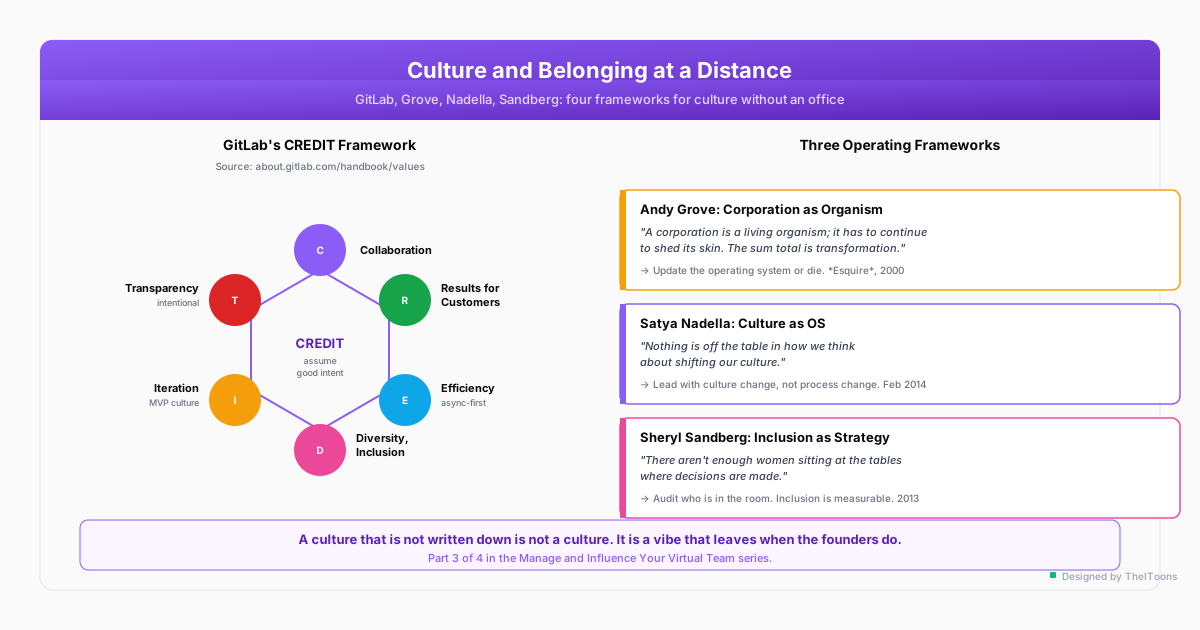
First, the CREDIT values. GitLab organizes its culture around six values that spell CREDIT:
- Collaboration
- Results for Customers
- Efficiency
- Diversity, Inclusion, and Belonging
- Iteration
- Transparency
The company documents the origin of each value and explicitly invites anyone, including non-employees, to suggest changes. The mechanism is described in the values section of the handbook.
Second, intentional transparency. Most companies default to secrecy and make exceptions for openness. GitLab reverses the default. The assumption is that any information that is not explicitly restricted is open. The result is that decisions, roadmaps, retrospectives, and even compensation philosophy are public. New hires read the handbook on day one and get the same context as a board member.
Third, asynchronous-first writing. The GitLab handbook specifies that most decisions should be made in writing, on a public issue or merge request, with the decision recorded in the same place. Real-time meetings are the exception, not the rule. The mechanism is documented in detail across the company's communication guidelines.
The GitLab system, distilled:
- Write the culture down. A culture that is not written down is not a culture. It is a vibe that leaves when the founders do.
- Default to transparency. Restrict only what is necessary. Make the restriction explicit.
- Make decisions in the open. The decision trail is more important than the decision itself.
- Invite contribution from outside. The handbook is open. The values are open. The culture is a public artifact.
The relevance to virtual teams is direct. Most distributed culture problems are not really culture problems. They are documentation problems. If the new hire cannot learn the culture from a written artifact, the culture does not exist in a way that survives the team scaling.
Andy Grove: the corporation as a living organism
Andy Grove's contribution to the culture question is older than the modern distributed-work conversation but more durable than most of it. Two specific framings carry the principle.
First, the corporation as an organism. From a 2000 Esquire interview:
A corporation is a living organism; it has to continue to shed its skin. Methods have to change. Focus has to change. Values have to change. The sum total of those changes is transformation. Andrew S. Grove, What I've Learned, Esquire, May 2000
The point is not that culture changes. The point is that the failure to change culture is a leading indicator of death. Grove's framing is brutal and useful: a culture that is not actively evolving is not a culture. It is a fossil.
Second, crisis as transformation. From a 1994 interview after the Pentium processor flaw:
Bad companies are destroyed by crisis. Good companies survive them. Great companies are improved by them. Andrew S. Grove, December 1994
The distributed-work era is the most acute cultural crisis most companies have faced in a generation. The companies that handled it well did not return to the old culture when the pandemic ended. They used the crisis to rebuild.
The Grove framework, applied to distributed teams:
- Treat the culture as a living system. It changes whether you manage the change or not.
- Use crises as transformation opportunities. The pandemic was one. The next one is coming.
- Be willing to shed what does not work. Including the parts of the old culture you liked.
- Document the change. The new culture is the one in the handbook, not the one in the founder's head.
Grove's contribution to the culture question is the framing most managers miss. Culture is not a soft topic. It is the operating system of the team, and like any operating system, it has to be updated.
Satya Nadella: culture as the operating system
Nadella's contribution to the culture question came in his first months as Microsoft CEO. The relevant primary source is the February 2014 internal email he sent to all Microsoft employees. The full text has been republished in his 2017 book Hit Refresh and is available in multiple primary archives.
The most-quoted passage:
Nothing is off the table in how we think about shifting our culture to deliver on this core strategy. Organizations will change. Mergers and acquisitions will occur. Job responsibilities will evolve. New partnerships will be formed. Tired traditions will be questioned. Satya Nadella, internal email to Microsoft employees, February 2014
What is striking about this quote in the context of distributed work is what Nadella did not say. He did not talk about products. He did not talk about markets. He did not talk about competition. The email is entirely about how the company operates and decides.
Nadella made the same observation in his 2018 Microsoft Build keynote, in a slightly different form:
We need to ask ourselves not only what computers can do, but what computers should do. Satya Nadella, Microsoft Build keynote, May 2018
The phrase translates directly to culture management. The question is not "what can the culture support?" It is "what should the culture support?" Most distributed teams are asking the first question. The high-performing ones are asking the second.
The Nadella framework, applied to distributed teams:
- Lead with culture change, not process change. The process is downstream.
- Question tired traditions. "We have always done it this way" is a smell, not a reason.
- Apply the "should" test. Not just to technology. To every policy, meeting, and approval gate.
- Make the new culture explicit. Write it down. Repeat it. Hire to it. Fire to it.
The relevance to virtual teams is that distributed work does not just change the location. It changes the operating system. Most teams try to run distributed work on a culture designed for in-person work, and the system fails.
Sheryl Sandberg: inclusion as a strategic asset
Sandberg's contribution to the culture question is the most direct of any leader on this list. Her 2013 book Lean In made the argument that inclusion is not a moral position. It is a strategic position. Companies that exclude women, that exclude minorities, that exclude the people who do not fit the dominant culture, leave money on the table.
The argument is built on three primary-source quotes. First, on the cost of exclusion, from Lean In:
There aren't enough women sitting at the tables where decisions are made. Sheryl Sandberg, Lean In, 2013
Second, on the upside of inclusion:
If we could get to a place of true equality, where what we do in life is determined not by gender but by our passions and interests, our companies would be more productive and our home lives not just better balanced but happier. Sheryl Sandberg, Lean In, 2013
Third, on the cultural signal that produces exclusion:
Women are given messages all through their lives that they shouldn't lead. Sheryl Sandberg, Lean In, 2013
The relevance to distributed teams is more subtle than it looks. Remote work changes the workplace physically. It does not automatically change the cultural signals that produce exclusion. A distributed team can be just as exclusionary as an in-person team, just in different ways.
The most common distributed exclusion pattern is the "core team vs. periphery" structure. The people who happen to be in the same time zone as the founders or who joined before the company went remote are treated as the core. Everyone else is the periphery. The result is a two-tier culture that no one planned.
Sandberg's framework, applied to distributed teams:
- Audit for exclusion. Whose voices are missing from the meeting, the channel, the document?
- Measure outcomes. Inclusion is not a vibe. It is a measurable set of behaviors.
- Question the cultural signals. Who speaks up? Who gets promoted? Who is asked to take notes?
- Treat inclusion as a strategic asset. The teams that include everyone ship better products.
The most useful single exercise for a distributed culture is to look at the last 10 decisions the team made and ask who was in the room when each was made. If the answer is the same people every time, the culture has a core-periphery problem whether you acknowledge it or not.
What all four playbooks have in common
Four leaders, four companies, one principle: distributed culture is not a softer version of in-person culture. It is a different culture, built on different artifacts, with different feedback loops.
The five moves that show up in every playbook:
- Write the culture down. A culture that is not written down does not scale. It does not survive turnover. It does not transfer to new hires.
- Default to transparency. Restrict only what is necessary. Make the restriction explicit.
- Update the operating system. The pandemic changed the hardware. The culture has to change to match.
- Treat culture as a strategic asset. Inclusion is not a moral position. It is a measurable contributor to product and financial outcomes.
- Audit for exclusion. The distributed team that does not audit will drift toward a core-periphery structure whether they plan it or not.
If you are running a distributed team and you are struggling with culture, the answer is almost never "more all-hands meetings" or "more Slack emojis." The answer is almost always "write the culture down, audit the decisions, and update the operating system."
What good looks like
A distributed team with a healthy culture looks like this from the inside.
The new hire reads the handbook on day one and gets a clear picture of how decisions are made, how performance is measured, and how conflicts are resolved. The handbook is not a marketing document. It is the actual operating system.
The team's decision log is public. Anyone can see what was decided, by whom, and on what basis. The log is the institutional memory. When someone leaves, the team's ability to make decisions does not change.
The team's meeting cadence is sparse and meaningful. There is a weekly decision block. There is a monthly retrospective. There is a quarterly planning session. There is an annual culture audit. The rest of the time, the team is heads-down.
The team's promotion and compensation decisions are transparent. People know what good performance looks like. People know what promotion criteria they are being measured against. People know what they would need to do to get to the next level.
The team's hiring decisions are audited for exclusion. The interview loop has been tested for bias. The compensation bands are public. The promotion rates by demographic group are tracked.
This is the system most distributed teams are trying to build. It is the system GitLab built. It is the system Microsoft is rebuilding. It is the system that Sandberg has been arguing for since 2013. None of it is original to any one leader. All of it is in the public record.
The uncomfortable part
If you are running a distributed team and you are not building this system, the question is not whether the culture is broken. The question is whether you have noticed yet.
Most distributed teams do not notice. They keep shipping. They keep growing. They keep hiring. The culture problem shows up in the metrics the team does not track: turnover among people in distant time zones, the percentage of decisions made by the same three people, the rate at which new hires from underrepresented groups leave in their first year.
The reason the problem shows up there is that the cultural signals are invisible to the people who are inside the dominant culture. The signals are obvious to everyone else.
The fix is not complicated. It is just uncomfortable. Write the culture down. Audit the decisions. Update the operating system. Treat inclusion as a strategic asset. The work is mostly in the writing and the auditing. The system runs itself after that.
Next in the series
Part 4 covers hiring, onboarding, and performance management. Trust and culture are the system. Hiring is the input that determines whether the system can run. That piece covers Patty McCord's "hire, reward, tolerate only fully-formed adults" framework, Brian Chesky's most-rigid-is-most-flexible principle, Kim Scott's Radical Candor model, and the OKR system Andy Grove invented.
Read Part 4: Hiring, Onboarding, and Performance Management →
Sources
- GitLab Handbook: Values, Communication, and Remote Work sections (about.gitlab.com/handbook, accessed June 2026).
- GitLab: "All-Remote" guide and team-practices documentation (about.gitlab.com/company, accessed June 2026).
- Grove, A. S. (2000). What I've Learned. Esquire, May 1, 2000.
- Grove, A. S. (1995). Swimming Across: A Memoir. Warner Books.
- Grove, A. S. (December 1994). Interview on the Pentium processor crisis, cited in Albert Yu, Creating the Digital Future, 1998.
- Nadella, S. (February 4, 2014). Internal email to Microsoft employees, "Meet the new CEO." Microsoft.
- Nadella, S. (2017). Hit Refresh: The Quest to Rediscover Microsoft's Soul and Imagine a Better Future for Everyone. Harper Business.
- Nadella, S. (May 7, 2018). Microsoft Build keynote, Seattle.
- Sandberg, S. (2013). Lean In: Women, Work, and the Will to Lead. Knopf.
- Wikipedia: GitLab, Sid Sijbrandij, Andrew S. Grove, Sheryl Sandberg (accessed June 2026).
Ready to Build a Brand That Reflects Your Operating System?
If you're scaling a distributed team and the brand and product experience do not reflect how the team actually works, we'd like to be part of the conversation.
If you're not ready to talk yet, subscribe below. We send one email a week with practical takes on distributed leadership, branding, and what actually works for growth-stage companies. No fluff, no sales sequence.