
Every system in the first three articles assumes one thing: you have hired well.
If you have not, the system breaks. The trust piece turns into a surveillance system. The culture piece turns into a clique. The communication piece turns into a chain of approval gates. The first three articles describe what distributed teams look like when the input is right. This one is about the input.
This is the fourth and final article in a four-part series on managing and influencing virtual teams.
- Part 1: Communication playbooks from the C-suite
- Part 2: Trust, autonomy, and results-only work
- Part 3: Culture and belonging at a distance
- Part 4: Hiring, onboarding, and performance management (you are here)
The five frameworks below come from leaders who have written, on the record, about how they hire, onboard, and review distributed teams. They agree on more than they disagree on. The disagreements are in execution, not principle.
Patty McCord: hire, reward, and tolerate only fully-formed adults
Patty McCord was Reed Hastings's chief talent officer at Netflix from 1998 to 2012. She co-authored the Netflix Culture Deck in 2009 and wrote the book Powerful: Building a Culture of Freedom and Responsibility in 2017. The deck has been viewed more than 30 million times. The book is the most-cited HR text of the last decade.
McCord's central claim is that most HR processes exist because the company failed to hire well. The processes are compensating for the wrong hire. The right approach is to fix the hire.
The relevant principles, drawn from the deck and the book:
First, the "keeper test." McCord's framework for retention is brutal and simple: for every employee, ask whether you would fight to keep them if they announced they were leaving. If the answer is no, give them a generous severance package now. The point is not to be cruel. The point is to keep the team composed of people you would fight for.
Second, the "brilliant jerk" rule. McCord's most-quoted contribution is that a brilliant jerk is a net negative. The cost of having a brilliant jerk on the team is higher than the cost of replacing them with a less-brilliant non-jerk. The principle is widely cited from the original deck and from McCord's book.
Third, fully-formed adults. McCord's argument is that most workplace policies exist to manage the worst case. The result is a workplace designed for the lowest common denominator of maturity. The Netflix counter is to treat every employee as a fully-formed adult: give them the context, give them the autonomy, and trust them to act.
The McCord system, applied to distributed teams:
- Run the keeper test on every employee quarterly. Act on the result.
- Refuse to hire brilliant jerks. The cost is real even when the contribution is high.
- Write policies for the best case, not the worst case. The system scales from the top.
- Pay top of market. The talent marketplace is real. If you are not paying for the top, you are not getting the top.
The relevance to virtual teams is direct. Distributed work is harder to monitor. The cost of a bad hire is higher because the bad hire's dysfunction is invisible to the rest of the team. The system that fixes this is the one McCord built: hire people you would fight for, pay them what they are worth, and trust them to act.
Brian Chesky: most rigid equals most flexible
Brian Chesky, co-founder and CEO of Airbnb, has been one of the most thoughtful writers on distributed work since 2020. His April 2022 letter to employees laid out Airbnb's "live and work anywhere" policy. The letter is widely cited in coverage of post-pandemic remote-work debates.
The relevant principle is Chesky's framing of Airbnb's office policy. The company kept offices open for collaboration. But the offices are not the default. The default is to work wherever the employee is most productive. The company has documented quarterly in-person gatherings for connection, but the day-to-day work is distributed.
The deeper principle, which Chesky has articulated in interviews and on his podcast, is that the most rigid structure produces the most flexibility. A team with no rules cannot operate. A team with too many rules cannot operate either. The right level of structure is the minimum amount that allows the team to act consistently without asking permission.
The Chesky system, applied to distributed teams:
- Define the non-negotiables. The things that must happen every time.
- Default to freedom everywhere else. The team does not need to ask permission to act.
- Protect the focus time. The office, when used, is for collaboration. The head-down work happens elsewhere.
- Schedule the in-person time. Connection does not happen by accident in a distributed team.
The relevance to virtual teams is the framing Chesky borrowed from Steve Jobs. Constraints produce creativity. A distributed team with no rules drifts. A distributed team with too many rules freezes. The right amount of structure produces speed.
Kim Scott: radical candor and the feedback system
Kim Scott is the author of Radical Candor: Be a Kick-Ass Boss Without Losing Your Humanity (2017) and the follow-up Radical Respect (2024). She has worked at Apple, Google, Twitter, and Dropbox. She is one of the few leadership authors who has operated inside the C-suite and written publicly about how feedback actually works inside organizations.
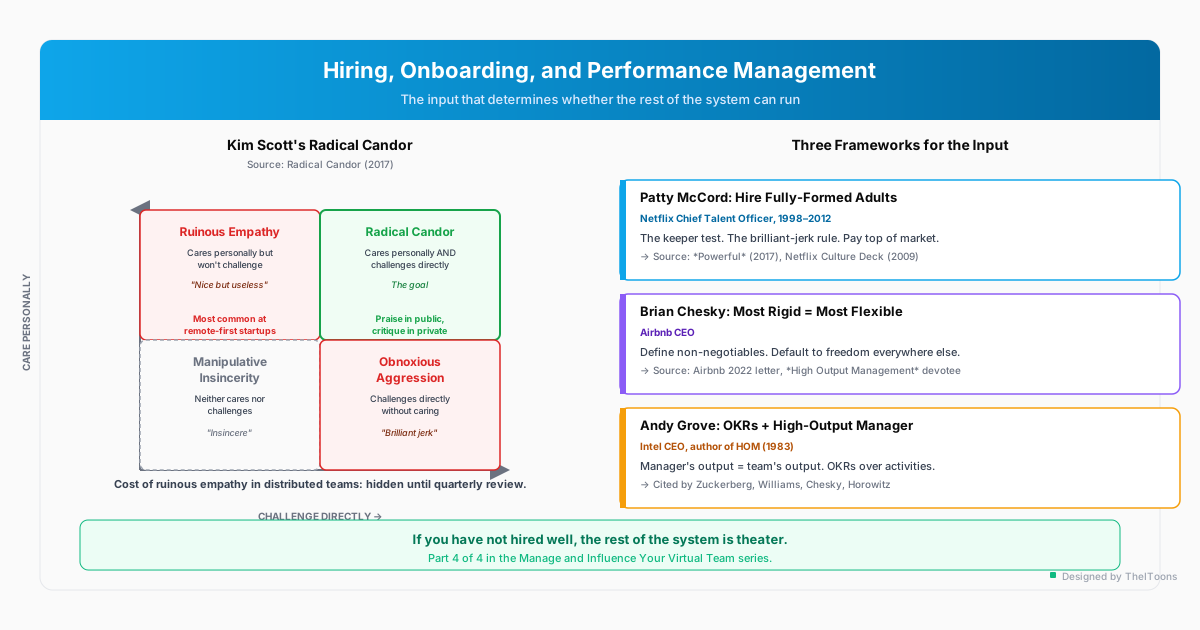
Scott's central framework is a 2x2 matrix. The two axes are "care personally" and "challenge directly." The four quadrants are:
- Radical Candor: care personally + challenge directly
- Ruinous Empathy: care personally but do not challenge directly
- Obnoxious Aggression: challenge directly but do not care personally
- Manipulative Insincerity: neither care personally nor challenge directly
The argument is that most managers fail in one of two predictable ways. They challenge directly without caring personally (obnoxious aggression), which produces fear and turnover. Or they care personally but do not challenge directly (ruinous empathy), which produces underperformance and resentment.
The relevant principle for distributed teams is the feedback asymmetry. In an office, the manager can see the bad performance. The body language, the missed deadlines, the late arrival are all visible. In a distributed team, the manager has to surface the bad performance through words. If the manager is not willing to challenge directly, the feedback never happens.
The Scott system, applied to distributed teams:
- Care personally. Get to know the human on the other side of the Slack handle.
- Challenge directly. Say the thing that needs to be said, in writing, in the meeting.
- Distinguish feedback from negativity. Negative feedback is 1-1. Negativity is the team channel.
- Praise in public. Criticism in private. The GitLab handbook says the same thing. The principle is robust.
The relevance to virtual teams is that the cost of not giving direct feedback is higher than the cost of giving it. A distributed team with poor feedback will discover the problem at the quarterly review, when it is too late to fix.
Andy Grove: OKRs and the high-output manager
Grove's High Output Management (1983) is the most-cited management text in Silicon Valley. The book's influence is documented on its Wikipedia page: Mark Zuckerberg of Meta, Evan Williams of Twitter, Brian Chesky of Airbnb, and Ben Horowitz of Andreessen Horowitz have all publicly cited it as foundational.
Two frameworks from the book are most relevant to distributed teams.
First, OKRs. Grove developed Objectives and Key Results at Intel in the 1970s. John Doerr brought the framework to Google in 1999. The book documents the framework in detail. The principle is simple: the objective is qualitative and ambitious, the key results are quantitative and time-bound. The employee proposes the objective, the manager agrees on the key results, and the rest of the process is owned by the employee.
Second, the high-output manager. Grove's central insight is that a manager's output equals the output of their organization. A manager's job is to multiply the output of the people they manage. The most important activities are the ones that produce leverage: hiring, performance review, one-on-ones, and training.
The book is full of specific tactical advice on running one-on-ones, conducting performance reviews, and managing in a knowledge-work environment. The advice is older than the distributed-work conversation but maps to it cleanly.
The Grove system, applied to distributed teams:
- Use OKRs to set outcomes. The objective is the what. The key results are the measure.
- Treat the manager's job as multiplying output. The manager's input is the team's output.
- Run the one-on-one. The most leveraged hour in the manager's week.
- Optimize for output, not presence. The manager who is in every meeting is not managing. The manager whose team is shipping is managing.
The relevance to virtual teams is that the framework predates the technology but works better with it. A distributed team with clear OKRs and regular one-on-ones can run itself. A distributed team without them will drift.
The interview loop that actually works
The five frameworks above all assume the same input: a rigorous interview loop. Most companies do not have one. Most companies have a hiring process that is mostly theater: a phone screen, a take-home, a few conversations, a reference check. The result is that most hires are not much better than random.
The interview loops that produce the best hires share five characteristics.
First, multiple interviewers. The loop is at least four people, all of whom have veto power. The principle is that no single interviewer can carry the bias.
Second, structured questions. Every interviewer asks the same questions in the same order. The principle is that comparison requires consistency.
Third, a hiring scorecard. Every interviewer scores the candidate on the same dimensions. The principle is that the decision is data-driven, not vibe-driven.
Fourth, a reference check with back-channels. The formal references are always positive. The back-channel references (people the candidate does not list) are where the real signal is.
Fifth, a deliberation that produces dissent. The decision is not unanimous by default. The interviewers are expected to disagree, and the disagreement is documented. The principle is that the dissenting views are the most valuable signal.
Google's interview loop is the most-cited version of this approach. Laszlo Bock, Google's former SVP of People Operations, wrote about it in his 2015 book Work Rules! The principle is that the loop is calibrated against actual performance data, and interviewers are routinely audited for accuracy.
The relevance to distributed teams is direct. A distributed team cannot afford a bad hire. The cost of replacing the hire is higher, the cultural damage is wider, and the visibility of the dysfunction is lower. The interview loop is the single highest-leverage process in the entire system.
Onboarding that works at distance
The interview loop gets the person in the door. The onboarding process is what turns them into a productive team member. Most distributed onboarding processes are broken in the same predictable ways.
First, too much information, too fast. Most onboarding dumps the entire handbook on the new hire in week one. The result is that the new hire learns nothing. The fix is to ship the handbook in pieces, with each piece attached to a specific task. The new hire reads the culture piece before their first team meeting. They read the communication piece before their first async update. They read the performance piece before their first OKR conversation.
Second, no clear owner. The new hire has a manager but no onboarding buddy. The manager is too busy to answer the small questions. The result is that the new hire spends the first month figuring out who to ask. The fix is to assign an onboarding buddy whose only job is to be available for the small questions.
Third, no early wins. The new hire spends the first month observing before they ship. The result is that the new hire feels useless and the team treats them as decoration. The fix is to ship a small but visible piece of work in week one. The work does not need to be strategic. It needs to be visible.
Fourth, no culture immersion. The new hire learns the company's stated values from the handbook and the company's actual values from the team. The two are never the same. The fix is to give the new hire an explicit tour of the unwritten culture. The tour is delivered by the manager in the first one-on-one, and it covers the things that are not in the handbook.
The distributed team that gets onboarding right treats the first 90 days as the most important period in the new hire's tenure. The distributed team that gets onboarding wrong treats it as a paperwork exercise.
Performance management that works at distance
The performance review is the system that ties the first three articles together. Communication is what makes the system run. Trust is what makes it scalable. Culture is what makes it sustainable. Performance management is what makes it real.
Three principles from the frameworks above.
First, the OKR conversation. The performance review is the conversation about whether the OKRs were met. The conversation is the review. The form is a summary. Most companies invert this. They treat the form as the review and the conversation as the formality. The fix is to start with the conversation, end with the form.
Second, the keeper test. McCord's framework applies here directly. The performance review is the formal moment to ask whether you would fight to keep the person. If the answer is no, the conversation should be about the severance, not the development plan.
Third, the radical candor feedback loop. The performance review should not contain surprises. If the feedback is being given well, the review is the summary of conversations that have already happened. The review is the documentation, not the discovery.
The distributed team that gets performance management right runs the review as a conversation about the work, not the person. The review documents the OKRs, the feedback, and the keeper-test answer. The conversation is the centerpiece. The form is the receipt.
The operating system
Pull the four articles together and you have an operating system for distributed teams.
- Communication is written-first, with synchronous time reserved for the decisions that need it.
- Trust is high because hiring is rigorous. Process is minimal because the input is good.
- Culture is documented, transparent, and updated as the team learns.
- Hiring is rigorous, onboarding is structured, and performance management is consistent.
The four parts are not independent. Communication depends on trust. Trust depends on culture. Culture depends on hiring. Hiring depends on the interview loop that actually works.
If you build all four, the system runs. If you skip one, the system breaks.
The reason most distributed teams fail is that they built communication and trust on top of a weak hiring process. The result is a well-documented team that cannot ship. The fix is to start over at the input. Fix the hiring loop. Build the onboarding process. Run the performance review as a conversation. The other three articles will start to work.
The series
- Part 1: Communication playbooks from the C-suite
- Part 2: Trust, autonomy, and results-only work
- Part 3: Culture and belonging at a distance
- Part 4: Hiring, onboarding, and performance management (you are here)
These four articles are a starting point, not a complete system. The complete system is built by the team, over time, in the handbook. The job of the leader is to make sure the handbook gets written.
Sources
- McCord, P. (2009). Netflix Culture Deck. Netflix internal document, published online.
- McCord, P. (2017). Powerful: Building a Culture of Freedom and Responsibility. Harper Business.
- Chesky, B. (April 2022). Airbnb letter to employees on live-and-work-anywhere policy. Airbnb Newsroom.
- Scott, K. (2017). Radical Candor: Be a Kick-Ass Boss Without Losing Your Humanity. St. Martin's Press.
- Scott, K. (2024). Radical Respect: How to Work Together Better. St. Martin's Press.
- Grove, A. S. (1983). High Output Management. Andrew S. Grove.
- Doerr, J. (2018). Measure What Matters. Portfolio.
- Bock, L. (2015). Work Rules! Insights from Inside Google That Will Transform How You Live, Lead, and Work. Twelve.
- Wikipedia: Brian Chesky, Andrew S. Grove, Andy Grove's High Output Management, Kim Scott (accessed June 2026).
- GitLab Handbook: Hiring and onboarding sections (about.gitlab.com/handbook, accessed June 2026).
Ready to Build a Distributed Brand That Ships?
If you're scaling a remote or distributed team and you need to translate the operating system into a brand and product that ships at scale, we'd like to be part of the conversation.
If you're not ready to talk yet, subscribe below. We send one email a week with practical takes on distributed leadership, branding, and what actually works for growth-stage companies. No fluff, no sales sequence.