
Most SaaS founders approach branding wrong. They think it's a design project — find someone to make a logo, pick some colors, done. Six months later they have a beautiful logo and still can't explain to a prospect why they should be chosen over the incumbent.
That's because branding isn't a design project. It's a positioning project.
This is the framework we use at TheIToons when we work with B2B SaaS founders — from Seed stage to Series B. It's not theory. It's the same process, refined across 40+ branding engagements.
The 3-Phase Branding Process for B2B SaaS
- Position — Who are you and why does it matter?
- Differentiate — What makes you impossible to ignore?
- Communicate — How do you make your positioning stick everywhere?
Most founders skip to phase 3. They hire a designer, get a logo, and then try to figure out positioning. That's backwards. You can't communicate a positioning you haven't defined.
Let's go through each phase.
Phase 1: Position
The positioning mistake most SaaS founders make
The most common positioning statement we see from B2B SaaS companies sounds like this:
"We help [role] automate [workflow] with [key feature] so they can [general outcome]."
This tells you nothing. Every competitor says the same thing. Your ICP — the VP of Engineering evaluating your tool — has heard this exact sentence 50 times.
Real positioning answers a different question: Why is it disproportionately harder to solve this problem without you?
The positioning test we use with clients
Ask yourself this: If you disappeared tomorrow, who would feel it first and why?
The answer to that question is your positioning. Not the market size, not the TAM, not the fancy AI features — the specific type of pain that only you solve.
For a SaaS company, the answer usually lives in one of these categories:
- Team composition — "Only a team with experience at [specific company type] can do this."
- Approach differentiation — "No one else solves it this way because most teams try to [wrong approach]."
- Customer intimacy — "We've been in the exact situation our customers are in, and we built exactly what we wished existed."
- Speed of delivery — "We ship in 2 weeks what takes our competitors 6 months."
Whatever your answer is, it becomes the foundation of everything else.
Building your positioning document
Write a single paragraph that answers:
- Who it's for — Not "B2B SaaS companies." Be specific. "Series A dev tooling startups with 20-100 engineers who are tired of maintaining internal scripts."
- What it is — Not a feature list. A category statement. "A declarative infrastructure layer that replaces your custom Terraform spaghetti."
- Why it matters — Connect to the specific pain that makes your customers' lives worse without you.
Once you have that, you're ready for phase 2.
Phase 2: Differentiate
The credibility problem in B2B SaaS
In B2B, differentiation has to be credible. A consumer brand can say "we're bold, we're daring." A B2B SaaS company can't afford that luxury — your buyers are professionals who will immediately ask "prove it."
The way you prove differentiation is through specificity. The more specific your claims, the more credible they become.
Compare these two statements:
Weak: "We help engineering teams ship faster."
Strong: "We cut feature releases from a 3-week cycle to same-day deploys. Engineering teams at 15 Series A+ companies have shipped 2x more features in the 90 days after onboarding."
The second statement is specific. It has a number. It has social proof. It implies a mechanism. That's what makes it credible.
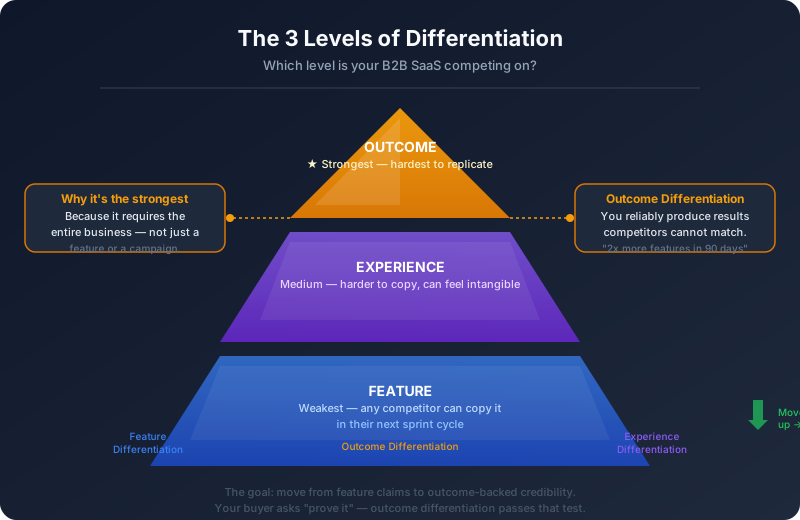
The 3 levels of differentiation in B2B SaaS
- Feature differentiation — Your product has a capability competitors don't. This is the weakest form because features can be copied.
- Experience differentiation — The way your product feels to use is different. The buyer journey, the onboarding, the support interactions. This is harder to copy but can feel intangible.
- Outcome differentiation — You reliably produce outcomes your competitors don't. This is the strongest form because it's the hardest to replicate.
You want to be in outcome differentiation territory. Here's how:
How to find your real differentiator
We run every new client through this exercise:
Step 1: List your top 5 customers. Not by ARR — by clarity of outcome.
Step 2: For each one, write: "Before working with us, [customer type] was failing at [specific goal]. After working with us, they [specific measurable outcome]."
Step 3: Look at the patterns. What outcomes appear more than once? What type of customer gets the most dramatic results?
Step 4: Ask: "Why can't a competitor who's 10x better funded replicate these results?" Your answer is your differentiator.
If the answer is "because they don't care about this segment" or "because their org is too big to move this fast" — that's a real differentiator. If the answer is "our AI is better" — that's a feature claim, not a differentiator. AI can be copied in 18 months.
Phase 3: Communicate
Building a brand system your whole team uses
Now that you've done the hard work of positioning and differentiation, you need to make it stick. This means building a brand system that communicates your positioning consistently — in your website, your pitch deck, your cold emails, your sales call scripts.
Without a system, you get drift. Each person on the team interprets the brand differently. The CEO says one thing in the pitch. The AE says something else on the call. The website says something different again. Your ICP gets confused and goes with the vendor they understood.
The 3 elements of a SaaS brand system
1. The one-liner A single sentence that a non-marketer can memorize and repeat. It has to pass the "so what?" test — if your ICP hears it and their first response is "yeah but why?", it needs work.
Format we use: "For [target customer] who [need or problem], [product name] is a [category] that [key differentiator]. Unlike [competitor or status quo], we [specific outcome]."
Example for a fictional dev tooling client:
"For engineering teams who are maintaining fragile internal scripts, Trainline is a deployment platform that treats infrastructure as code that's actually readable. Unlike Terraform, we generate the configuration from your actual running system — so it never drifts."
2. Visual identity that reflects your positioning Your brand's visual language should reinforce your positioning. A security-focused SaaS shouldn't look playful. A developer tooling company shouldn't look corporate. The colors, typography, and illustration style all need to signal credibility to your ICP.
The most common mistake we see: SaaS companies copy the visual language of enterprise software because they think it makes them look "professional." It makes them look like every other boring tool in the space.
3. A library of proof points Your sales team shouldn't be making up social proof on the fly. Build a structured library of:
- 5 case studies with specific numbers (not "2x faster" — "40% reduction in failed deploys over 90 days")
- 10 testimonials by role, not company
- 20 competitor comparison statements (not disparaging — factual)
- 5 "day one" success stories (customers who got results fastest)
When your sales team has to answer "how are you different from [competitor]?" — the answer should be in the proof library, not improvised.
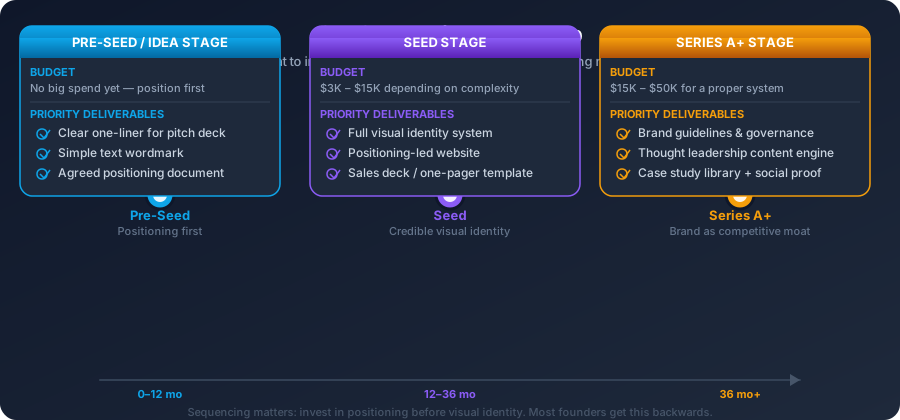
The SaaS Branding Roadmap: What to Prioritize at Each Stage
Pre-Seed / Idea Stage: Positioning first, visual identity second
You don't need a full brand system yet. What you need:
- A clear one-liner for your pitch deck and landing page
- A simple wordmark (can be a text logo initially)
- A positioning document your co-founders agree on
The mistake: spending $20K on a brand identity when you haven't validated the positioning with real customers. If you change your ICP mid-way through beta, your expensive logo becomes worthless.
Seed Stage: Credible visual identity
Once you have 10+ paying customers and clear signals that you've found product-market fit, invest in:
- A full visual identity system (logo, colors, typography, illustration style)
- A website that communicates your positioning clearly
- A one-pager or pitch deck template that sales can use
Budget: $3K–$15K depending on complexity
Series A+: Brand as competitive moat
By Series A, your brand is a recruiting tool, a sales asset, and a market signal. This is when you invest in:
- A comprehensive brand guidelines document
- Content that establishes thought leadership (this blog, for example)
- Case study library and social proof infrastructure
- Customer advisory board and brand ambassador program
Budget: $15K–$50K for a proper system
What Most SaaS Branding Agencies Get Wrong
We've worked with founders who came to us after a bad experience with another agency. The pattern is always the same:
They shipped a beautiful logo. They didn't build a positioning system.
The agency asked for preferences, mood boards, inspiration links. They came back with 3 logo concepts. The founder picked one. Everyone celebrated.
Six months later: nothing had changed in how the company's ICP perceived them. The logo was prettier but the positioning was still fuzzy.
That's why we do positioning before design. The design should be a consequence of the positioning work, not a parallel track.
If an agency shows you mood boards before asking about your competitors, your ICP's specific pain points, and what outcomes your best customers get — walk away. They're going to make something beautiful that doesn't actually work.
How to Evaluate a SaaS Branding Agency
Look for agencies that:
- Ask about positioning before aesthetics. If they open with "what's your color palette preference?" — they don't know how to do real brand work.
- Show outcome metrics in case studies. "We helped them rebrand" isn't a case study. "We helped them go from 15% outbound reply rate to 32% by repositioning from 'CRM tool' to 'sales intelligence platform'" is.
- Specialize in your ICP. B2B SaaS branding is different from consumer branding. An agency that does both is probably great at one and mediocre at the other.
- Include strategy in the deliverable. If the deliverable is just files (logos, colors) without a positioning document and a message framework — you're paying for execution, not strategy.
Start Here: Your 30-Day Branding Sprint
If you're early-stage and can't hire an agency yet, do this work yourself:
Week 1: Write your positioning document. Answer: Who is this for? What specific pain do we solve? Why can't competitors replicate this?
Week 2: Test your one-liner. Use it in 10 cold outreach emails. See which version gets the most replies.
Week 3: Audit your website. Every page should be able to answer: "Who is this for and why should they care?" If it can't, rewrite it.
Week 4: Identify your top 3 proof points. Find the most compelling outcomes you've delivered and document them with specific numbers.
Thirty days from now, you'll have a positioning foundation you can build on — whether you hire an agency or not.
The Honest Answer on SaaS Branding ROI
Branding is not a short-term play. If you're looking for leads in 90 days, buy ads.
Branding compounds. A consistent brand message over 18 months creates recognition, trust, and a pipeline that self-reinforces. At TheIToons, our clients who invest in branding consistently outperform those who treat it as optional — not because the logo is prettier, but because their ICP understands what they do and why it matters.
The question isn't whether you can afford to invest in branding. It's whether you can afford not to — when your competitors are doing it right now.
Ready to build a brand that actually works for your SaaS?
Subscribe to get our SaaS branding frameworks delivered to your inbox — plus case studies, pricing structures, and the positioning documents we use with clients.